about
● links
● archives
Feminist Reaction to the Unconventional Female Nude
Wednesday, October 17, 2012 @ 10:44 PM
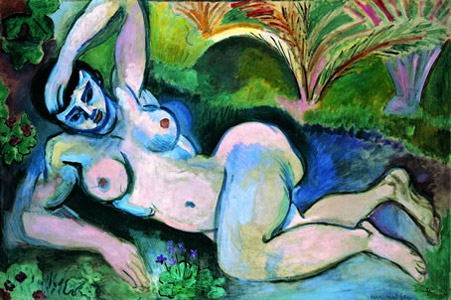
Matisse's works, such as Blue Nude, from 1907, in which he depicts a woman's body in a twisted, distorted position, a well-muscled body (not conventional nor considered attractive at the time), and a mask-like face, elicited critiques from both Art Historians and feminist Art Historians alike. Feminists saw Matisse's portrayals of female bodies as insulting as well as a symbol of male dominance over them. As Carol Duncan says of another of Matisse's works, Carmelina, "...Matisse celebrates his control over women as a way of boasting of his virility." ( It is clear that these thoughts John Elderfield, Pleasuring Painting) were echoed across the majority of the feminist community, as Griselda Pollock says, "High Culture plays a specifiable part in the reproduction of women's oppressions in the circulation of relative values for the ideological constructs of masculinity and femininity." (Pleasuring Painting) Some female students at the Art Institute School in chicago, along with a large student body of males, went so far as to burn Blue Nude and two other pieces by Matisse in effigy for having, "...violated the female body because of the way he deployed his aesthetic medium." (Pleasuring Painting)
It took many years, but gradually views on Blue Nude and Matisse's other woks changed. Marilynn Lincoln Board, a well-known feminist Art Historian, has a different opinion from earlier feminists. "She sees difference expressed in most of the artist's work, and most clearly in the so-called odalisques of his Nice period of the 1920s, because they exemplify...conventional imperialist attitudes towards the French colonies in Africa. Thus, the odalisque is a metonym for the controlling, exploiting, invading, European male." (Pleasuring Painting)
Written by Chelsea Reintjes
